Loading...

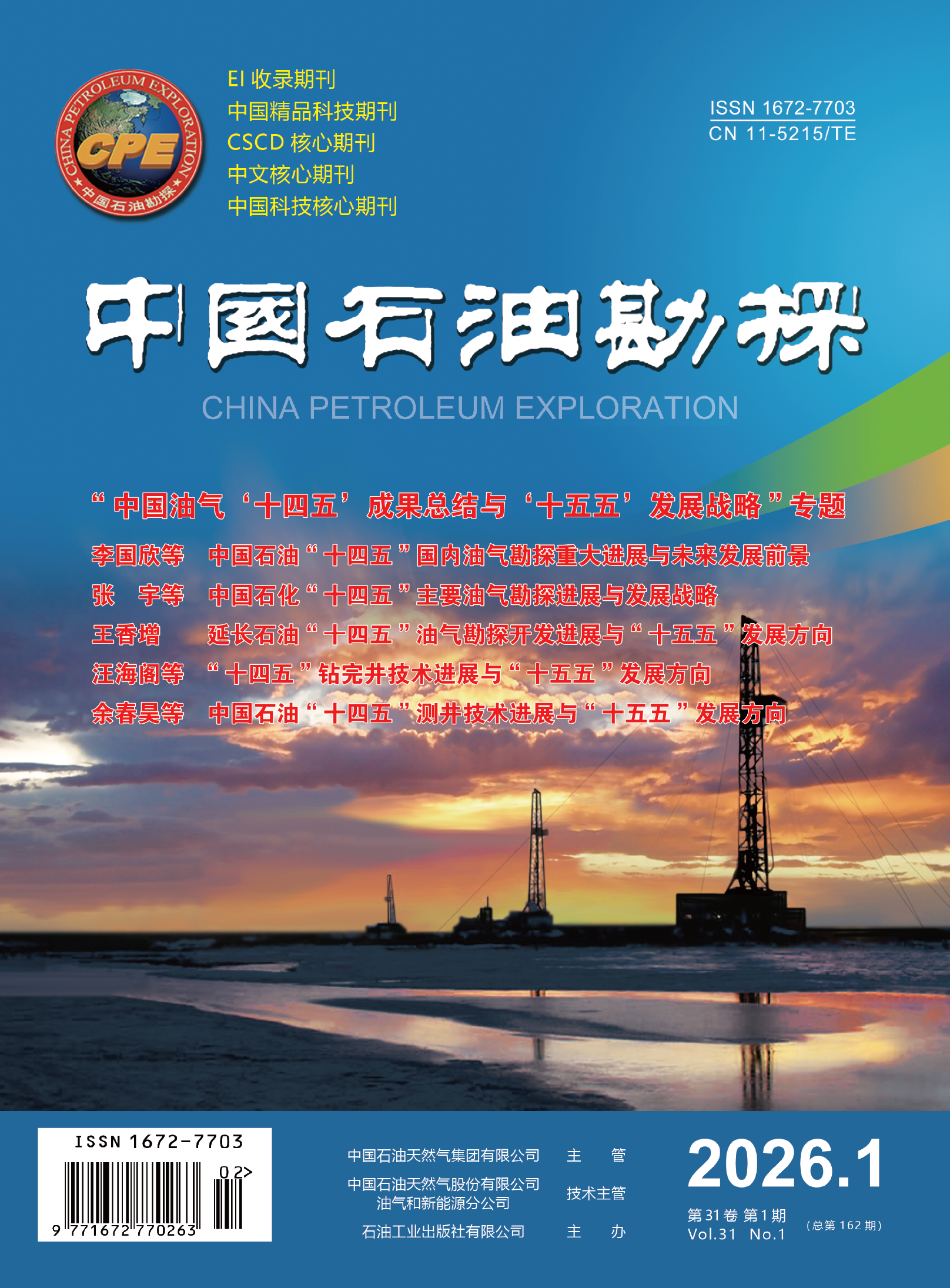
Current Issue

15 January 2026, Volume 31 Issue 1
    Li Guoxin, Yang Yu, Song Yong, Zhang Guosheng, Guo Xuguang, Yan Weipeng, Huang Fuxi, Wang Shaoyong, Yuan Ming
    Major progress in oil and gas exploration during the 14th Five–Year Plan period and future prospects of PetroChina
    2026, 31(1):  1-13.  Asbtract ( 547 )   DOI: 10.3969/j.issn.1672-7703.2026.01.001
    References | Related Articles | Metrics
    During the 14th Five–Year Plan period, PetroChina Company Limited (hereinafter referred to as “PetroChina”) has been committed
    to high-quality development of oil and gas exploration, and vigorously advanced efficient exploration guided by the Seven–Year Action Plan. As a result, 30 significant results in five major fields have been achieved in domestic oil and gas exploration, including marine carbonate rocks, continental lake basin lithologic–stratigraphic traps, foreland thrust belts, shale oil and gas, and deep coal rock gas, forming nine largescale oil reserve areas and seven large-scale natural gas reserve areas by intensive exploration activities. The exploration achievements show distinct characteristics of multiple breakthroughs in various fields on the plane, simultaneous exploration of both shallow and deep formations in vertical direction, and parallel advancement of both conventional and unconventional resources. Specially, breakthroughs have been made in long-stalled fields such as the southern margin of Junggar Basin and the piedmont zone of southwestern Tarim Basin. In addition, breakthrough progress has been made in oil and gas geological theories in aspects such as marine carbonate rocks, lithologic–stratigraphic traps in continental lake basin, and coal measure whole petroleum system. Furthermore, key engineering technologies have been developed, represented by 3D seismic imaging in “double high” and “double complex” areas, efficient well drilling and completion in deep to ultra-deep formations, and geology and engineering integrated fracturing for deep coal rock gas. In response to the new situation of oil and gas exploration at home and abroad during the 15th Five–Year Plan period and resource endowment in China, PetroChina will adhere to efficient exploration, strengthen risk exploration in key zones in the five major fields, actively prepare for strategic replacement areas and major replacement fields, focus on centralized exploration in “10 oil and 10 gas” exploration fields, and promote continuous large-scale reserve growth of conventional oil and gas and rapid development of unconventional resources, so as to consolidate the resource foundation for high-quality development.

    Zhang Yu, Zhao Peirong, Liu Shilin, Liu Chaoying, Wang Huiyong, Che Shiqi, Li Meng
    Main exploration progress during the 14th Five-Year Plan period and development strategy of Sinopec
    2026, 31(1):  14-27.  Asbtract ( 237 )   DOI: 10.3969/j.issn.1672-7703.2026.01.002
    References | Related Articles | Metrics
    Since the 14th Five Year Plan, Sinopec has focused on three major tasks: expanding resources, increasing reserves, and expanding mining rights. It has strengthened research on basic scientific issues and continuously tackled engineering supporting technologies. Seven strategic breakthroughs have been achieved: ① Innovate and form a theoretical and technological system for shale oil exploration, and make significant breakthroughs in various types of terrestrial shale oil exploration in multiple regions such as Jiyang, Fuxing, and northern Jiangsu; ② We have improved the theory of "dual enrichment" for shale gas, and made significant breakthroughs in the Permian and Cambrian systems in eastern and northern Sichuan, as well as western Sichuan; ③ We have innovatively established a theory and exploration and development technology system for controlling oil and gas accumulation through strike slip faults in marine carbonate rocks, which forming a 1 billion ton scale reserve area in Shunbei; ④ Innovate the "fault phase" dual control oil and gas enrichment model and exploration technology, and achieve large-scale storage increase in the Sichuan Basin, Junggar Basin, and Ordos Basin; ⑤ Carry out refined exploration in mature areas and achieve large-scale discoveries in the "three new" fields such as lacustrine carbonate rocks, deep depression, bedrock buried hills, et al; ⑥ Strengthening the evaluation of oil and gas reservoirs and targets, significant breakthroughs have been made in new areas such as the Songliao Basin, western mountain front belts, and sea areas; ⑦ Significant breakthroughs have been made in the enrichment theory and exploration and development technology of gas reservoirs, as well as in deep coalbed methane formations such as Daniudi and Fuxian in the Ordos Basin. Looking ahead to the future, opportunities and challenges coexist in the upstream exploration of Sinopec. It is necessary to seize historical opportunities, scientifically respond to challenges and win the seven-year offensive battle to expand and protect mining rights, the shale revolution to increase storage benefits, the strategic breakthrough battle for deep oil and gas in the central and western regions, the proactive battle for deep natural gas in the eastern region, and the tough battle for oil and gas exploration in the middle and deep sea areas, striving to achieve major breakthroughs and new discoveries in oil and gas, and contributing to safeguarding national energy security.
    Wang Xiangzeng
    Progress in Oil and Gas Exploration and Development of Yanchang Petroleum Group during the 14th Five-Year Plan Period and Future Directions for the 15th Five-Year Plan Period
    2026, 31(1):  28-42.  Asbtract ( 152 )   DOI: 10.3969/j.issn.1672-7703.2026.01.003
    References | Related Articles | Metrics
    During the 14th Five Year Plan period, Shaanxi Yanchang Petroleum (Group) Co., Ltd. (referred to as Yanchang Petroleum) continued to increase its exploration and development efforts, and made significant progress in the exploration, development, and theoretical technology of low-permeability tight oil, shale oil, and natural gas in the Ordos Basin. First, in the field of low-permeability tight oil, we continue to deepen the theory of “alternating” oil accumulation in ultra-low permeability, propose the “spatially and temporally ordered near source oil accumulation” model for tight oil, and form low-permeability tight oil control rate increasing permeability water injection technology and open hole well area secondary development technology. We have added nearly 3.5 × 10⁸t of proven oil geological reserves and achieved stable production of crude oil for 18 consecutive years with an annual output of over 10 million tons. Second, in the field of shale oil, the exploration direction of “Class I construction and production, Class II research and development, and Class III reserves” has been established, and an integrated technical system of shale oil geology, engineering, and development has been constructed. We have newly added the proved geological reserves of shale oil of nearly 5000 × 104t, with an annual output of 35 × 104t. Third, in the field of natural gas, the theoretical understanding of “frequent migration and sand control of shallow water environment shorelines” in the Upper Paleozoic has been deepened, and a stacking and accumulation model of weathered crust gas reservoirs and carbonate rock inner gas reservoirs in the Lower Paleozoic has been proposed. The exploration of new types, new layers, and new fields has achieved initial results. We added approximately 2800 × 108m3 of proven geological reserves of natural gas, with an annual output exceeding 10 billion cubic meters. Based on a systematic review of the achievements and the theoretical and technological advancements in oil and gas exploration and development during the 14th Five-Year Plan period, Yanchang Petroleum has outlined its strategic directions for the 15th Five-Year Plan. First, the company will continue to uphold the resource strategy of “stabilizing oil production, increasing gas output, and strengthening unconventional resources.” Efforts will be focused on overcoming key technological challenges in the exploration of ultra-low permeability–tight oil, tight sandstone gas, and carbonate gas to solidify the resource foundation for long-term development. Second, Yanchang Petroleum will vigorously expand unconventional resources such as shale oil, coalbed methane, and shale gas, fostering strategic replacement reserves and striving to drive continuous innovation and high-quality development in oil and gas exploration and production.
    Han Yaqin, Mao Junli, Wang Qiaohong, Wang Huo, Li Wenbo, Zhu Chenglin
    Research on Differentiated and Fine Management of the Oil and Gas Exploration and Development within Ecological Protection Red Line Area
    2026, 31(1):  43-49.  Asbtract ( 99 )   DOI: 10.3969/j.issn.1672-7703.2026.01.004
    References | Related Articles | Metrics
    Implementing differentiated and refined management of oil and gas exploration and development within the ecological protection red line, coordinating the relationship between oil and gas resource development and environmental protection, is conducive to promoting the oil and gas industry’s “development in protection, protection in development”, promoting the increase of oil and gas resources reserves and production, and assisting the new round of breakthrough strategic actions in mineral exploration. On the basis of systematically sorting out the control rules for oil and gas exploration and development within the domestic ecological protection red line and the management practices for oil and gas exploration and development within foreign nature reserves, this study analyzes the problems existing in the current policies for controlling oil and gas mining rights within the ecological protection red line. It is believed that more scientific and reasonable control policies and access requirements for exploration and development activities should be formulated according to the characteristics of oil and gas resource exploration and development, and based on different protected objects. The control and evaluation of oil and gas resource exploration and development activities within the ecological protection red line should be strengthened, and various requirements for ecological protection should be strictly implemented with high standards.
    Bai Xuefeng, Li Junhui, Li Jingsheng, Wu Jingfeng, Wang Biao
    Exploration Situation and Development Strategy of Daqing Oilfield Company During the “14th Five-Year Plan” Period
    2026, 31(1):  50-63.  Asbtract ( 154 )   DOI: 10.3969/j.issn.1672-7703.2026.01.005
    References | Related Articles | Metrics
    During the 14th Five-Year Plan period, in the face of a complex situation where exploration targets gradually shifted toward “lowgrade, unconventional, hard-to-exploit, and deep systems,” along with numerous challenges in fundamental theoretical understanding and supporting technologies, we adhered to the overall layout of “focusing on Northeast China, accelerating development in the West, balancing conventional and unconventional resources, advancing both oil and gas, and addressing both shallow and deep targets.” By deepening fundamental research, advancing cutting-edge theoretical innovation, and accelerating technological iteration and upgrading, we achieved multiple strategic breakthroughs and large-scale reserve increases across various fields, strongly supporting the robust rise of the oilfield’s “second curve.” Through continuous research efforts, the company made groundbreaking progress in several key areas: developing a comprehensive oil and gas system theory, innovating a dual sweet spot evaluation technique, and pioneering the in-situ accumulation theory of shale oil in the Gulong Formation, driving large-scale reserve increases and profitable production in conventional oil, tight oil, and shale oil in the northern Songliao Basin. We refined the theory of hydrocarbon accumulation in complex faulted basins, established unconventional accumulation models, and achieved significant breakthroughs in the exploration of tight oil within the source rock of the Hailar Basin. By deepening our understanding of the enrichment laws of multi-phase superimposed basin hydrocarbons, we innovated a high uplift beltcontrolled accumulation model, confirming a 300-billion-cubic-meter giant gas field in the Maokou Formation of the Sichuan-Chongqing exploration area. We redefined the migration and evolution patterns of foreland lacustrine basins, achieving a historic breakthrough in shale oil in the Sichuan-Chongqing region. By constructing a reef-shelf fault-karst composite accumulation model, we overcame extreme geological conditions such as “ultra-depth, ultra-high pressure, and ultra-high temperature,” forming a preliminary 100-billion-cubic-meter reserve zone in the Yuman reef-shelf belt of the eastern Tarim Basin. Looking ahead, in the face of severe challenges such as significantly reduced mining rights areas, increasingly complex exploration targets, and heightened difficulties in profitable exploration, we will seize the opportunities of strategic transformation, forge a new path toward high-quality development characterized by resource succession, technological leadership, and green intelligence. We will scientifically plan the direction and key tasks of oil and gas exploration, comprehensively advance five major projects: large-scale reserve increases in the Songliao Basin, three-dimensional reserve increases in the Sichuan-Chongqing exploration area, rapid reserve increases in the eastern Tarim Basin, succession reserve increases in the Hailar Basin, and new exploration area and field reserve increases. We will strive to reach the peak of reserve growth, intensify efforts to achieve production-storage balance, and take on the responsibility of building a world-class modern century-old oilfield, continuously contributing Daqing’s strength to ensuring national energy security.

    Zhao Zhe, Fan Liyong, Huang Zhengliang, Cheng Dangxing, Hu Jianling, Chu Meijuan, Yan Wei, Hu Xinyou, Mao Zhiqi, Cao Jingjingi, Tian Lianjie
    The progress of oil and gas exploration during the 14th Five-Year Plan period and future exploration directions in the Ordos Basin
    2026, 31(1):  64-79.  Asbtract ( 264 )   DOI: 10.3969/j.issn.1672-7703.2026.01.006
    References | Related Articles | Metrics
    It has long been dominated by conventional oil and gas exploration and development in the Ordos Basin. It has gradually shifted to intra-source exploration with the increasing exploration maturity.However, facing the long-term demand for stable oil and gas production, exploration encounters significant challenges. This paper systematically reviews the major exploration progress, achievements, and key geological understandings of hydrocarbon accumulation in the Ordos Basin since the 14th Five-Year Plan period (1) Effective source rocks are developed in the Mesozoic, Upper Paleozoic, and deep formations in the Ordos Basin. Among them, the Mesozoic and Upper Paleozoic source rocks are highly established and serve as the main hydrocarbon source layers for exploration and development. Two sets of low-abundance source rocks are developed in the Ordovician, with the Wulaleke Formation source rock being thick and continuously distributed. Although the individual layers of the Ordovician inter-salt are thin, the cumulative thickness is significant, endowing them with strong large-scale hydrocarbon generation potential. (2) An innovative understanding is that the source rocks in these three major stratigraphic sequences not only exhibit strong hydrocarbon generation capacity but also favorable reservoir properties, marking a shift from a single-source rock concept to a source-reservoir integrated understanding. Intra-source or near-source accumulation is more conducive to hydrocarbon enrichment. (3) Based on the exploration maturity and established degree of source rocks, future exploration will be conducted in two tiers: the first tier focuses on the intra-source realistic exploration fields, including Mesozoic shale oil, Upper Paleozoic coalbed gas, and intra-source limestone tight gas; the second tier targets are exploration fields such as the Lower Triassic Yanchang Formation in the Mesozoic, Upper Paleozoic transitional facies shale gas, Ordovician inter-salt, western Ordovician, and Cambrian-Mesoproterozoic strata. To advance exploration, it is essential to deepen fundamental geological research and innovative theories of hydrocarbon accumulation in new fields, while strengthening 3D seismic deployment, enhancing supporting exploration technologies, and optimizing reservoir stimulation techniques. These efforts aim to promote large-scale reserves in realistic exploration fields and achieve breakthroughs in new strata and fields, providing resource guarantees for longterm stable oil and gas production in the Ordos Basin.
    YangHaijun, XuZhenping, YangXianzhang, TangYangang, MoTao, ChenCai, XieZhou, LuoXinsheng, WangBin
    Progressand Future Direction of Oil and Gas Explorationin theTarim Basinduring the “14th Five-Year Plan” Period
    2026, 31(1):  80-99.  Asbtract ( 156 )   DOI: 10.3969/j.issn.1672-7703.2026.01.007
    References | Related Articles | Metrics
    At the beginning of the "14th Five-Year Plan" period,the Tarim Oilfield faced anurgentt ask of increasing natural gas reserves on alarge scale and an unclear direction for expanding oil reserves. Over the five-year period, focusing on major potential exploration areas, based on anewround of structural modeling and full-strata in terpretation, the fault combination characteristics in the stable-transition zone of the Kelasu structural belt were re-recognized. Atotal of 26 new gas reservoirs were discovered in the Bozi-Dabei area, basically completing the construction of a1-trillion-cubic-meter large gas area. The fault-controlled hydrocarbon accumulation model featuring "multi-stage hydrocarbon supply from the Cambrian, reservoir control by fault fracture zones, in-situ vertical migration and accumulation by strike-slip faults, and segmented enrichment in fault zones" was established. This formed the geological understanding that strike-slip faults control reservoirs, hydrocarbon accumulation, and enrichment, and identified the Fuman1-billion-tonlarge oilfield. Centering on the characterization of hydrocarbon-generating sags, and taking the hydrocarbon-bearing system, near-source regional reservoir-cap combinations, and large-scale hydrocarbon-transporting fault characterization ask eypoints, continuous breakthroughs were achieved in risk exploration in four new areas and fields: the Carboniferous-Permian in the southern Tarim piedmont, the Cretaceous-Triassic in the Kuqa piedmont, the Upper Cambrian in the western northern Tarim, and the Ordovician in the Maigaiti slope of the platform-basin area. During the exploration practice, an efficient exploration path for ultra-deep layers was formed, which is based on high-quality basin-wide frame work research, takes near-source exploration as the direction and basic approach, regards risk exploration as the key, a dheres to the advanced deployment of 3D seismic surveys, and continues to tackle key seismic technologies. In the future, the exploration will be based on hydrocarbon-generating centers and close to source rocks, focusing on five major fields: the southern Tarim piedmont, the middle combination of Kuqa, the western northern Tarim, the periphery of Awati, and the sub-salt of the Cambrian, to find strategicre placement areas.
    Wu Keqiang, Fan Caiwei, You Junjun, Chen Lin, Man Xiao, Tan Jiancai
    Exploration advances and development directions of hydrocarbons in the Beibuwan Basin during the 14th Five-Year Plan period
    2026, 31(1):  100-115.  Asbtract ( 183 )   DOI: 10.3969/j.issn.1672-7703.2026.01.008
    References | Related Articles | Metrics
    The Beibuwan Basin serves as a crucial oil and gas production base in the northern South China Sea. During the 14th Five-Year Plan period, exploration faced key challenges such as the enrichment mechanism and development technology for offshore shale oil, natural gas and buried-hill accumulation patterns in deep sags, differential enrichment of deep low-permeability reservoirs, and accurate identification of subtle traps. This paper systematically reviews theoretical advances and technological progress during this stage, with the following key achievements: an innovative “source-reservoir-migration” triple-coupling enrichment model for offshore shale oil was established, along with large-volume fracturing technology for confined offshore spaces, leading to China’s first breakthrough in offshore shale oil exploration and the subsequent discovery of the Weizhou 11-6 oilfield—the largest in the western South China Sea; a “lithofacies-paleogeomorphology-structure” triple-control mechanism for carbonate buried hills and a “high-maturity source-rock docking with overpressure charging” accumulation model for granite buried hills were developed, guiding a series of major discoveries in buried-hill and deep natural gas exploration in the Weixinan Sag; the mechanism of “source-ridge controlled migration, pervasive-sequential charging, and differential accumulation” was elucidated, promoting a breakthrough in deep low-permeability reservoirs in the Weixinan Low Uplift and adding over 25 million tons of oil-equivalent in proven reserves. These research outcomes mark a systematic shift in the basin’s exploration from conventional to unconventional resources, from shallow to deep layers, and from structural to structural-lithologic traps, significantly expanding the resource potential. Future efforts should focus on four key directions: source-reservoir coupled buried hills, mid-deep structural-lithologic traps, laminated/interbedded shale oil, and potential hydrocarbon-rich sags. Strengthening integrated theoretical and technological research will provide solid support for achieving large-scale reserve growth in the basin and ensuring national energy security.
    Liu Jun, Peng Guangrong, Lin Heming, Zhang Xiangtao, Liu Jie, Liu Daoli
    Progress and Development Direction of Oil and Gas Exploration in the Eastern Pearl River Mouth Basin during the 14th Five-Year Plan Period
    2026, 31(1):  116-130.  Asbtract ( 120 )   DOI: 10.3969/j.issn.1672-7703.2026.01.009
    References | Related Articles | Metrics
    The Pearl River Mouth Basin is a large Cenozoic oil and gas-bearing basin on the northern continental margin of the South China Sea, with multiple large and medium-sized oilfield clusters such as Huizhou, Xijiang, and Lufeng already discovered. During the 14th Five-Year Plan period, further exploration successes were achieved in the shallow-middle conventional fields of the eastern part of the basin, while actively transitioning toward the "four new" (new structural zones, new depressions, new stratigraphic systems, and new types) frontier areas. Facing multiple challenges such as deep layers, deep water, and complex lithology, exploration efforts actively sought breakthroughs, achieving significant theoretical advancements and technological innovations, leading to major exploration results. In deep exploration, addressing issues like "closure fragmentation, rapid reservoir facies change, and oil-gas preservation difficulties" in the Zhu I Depression's deep layers, a new "Composite Marginal Basin Deep Oil and Gas Exploration Theory and Technology System" was innovatively developed, breaking traditional constraints. This led to the discovery of large and medium-sized oilfields such as Huizhou 19-6 and Lufeng South in the deep layers of the Huizhou and Lufeng Depressions, with Huizhou 19-6 being China's first offshore deep-ultradepth clastic rock large-scale integrated oilfield. In deep-water exploration, the innovative "Marginal Core Complex-Rifting Depression Oil and Gas Accumulation Theory" guided the discovery of the Kaipingnan billion-ton oil and gas field, marking China's first deep-water deep-layer billion-ton light oilfield, fully demonstrating the broad prospects of China's deep-water deep-layer exploration. In shallow-middle layer follow-up exploration, breakthroughs were made in addressing oil-gas migration challenges, with innovative models like the "helical three-dimensional migration" guiding a series of followup discoveries around the Xijiang, Huizhou, and Panyu oilfields. In deep-water natural gas exploration, research on deep-water reservoir formation mechanisms and lithological trap formation mechanisms led to commercial or potential commercial discoveries such as the Liwan 4-1 gas field, with Liwan 4-1 representing China's first major breakthrough in the ultra-deepwater carbonate rock exploration field. During the 15th Five-Year Plan period, the Pearl River Mouth Basin (eastern part) will continue to scientifically plan the strategic direction and priorities of oil and gas exploration, focusing on four key exploration areas: enriched Paleogene deep/ultradepth, enriched Neogene shallow-middle lithology, deep-water natural gas, and potential enriched zones. Efforts will accelerate the realization of large-scale oil and gas resource reserves, while actively preparing for the exploration of prospective fields such as buried hills, Mesozoic strata, glutenite,and shale oil, strengthening the resource foundation for high-quality development.
    He Faqi, An Chuan, Zhang Wei, Liu Zhen, Song Daofu, Zhao Zhen
    Natural Gas Exploration Discoveries, Accumulation Characteristics, and Accumulation Models in the Northern Margin Transitional Zone of the Ordos Basin
    2026, 31(1):  131-145.  Asbtract ( 126 )   DOI: 10.3969/j.issn.1672-7703.2026.01.010
    References | Related Articles | Metrics
    Gas accumulation conditions in the Hangjinqi area of the northern marginal transition zone of the Ordos Basin are highly complex, and exploration concepts have undergone a major evolution—from “local structural gas control” to “large-scale lithologic trap–controlled gas accumulation,” and from “single low-saturation lithologic gas reservoirs” to “ordered distribution and differential enrichment of multiple reservoir types.” In particular, since the “14th Five-Year Plan” period, significant discoveries have successively been made in the Xinzhao play, the Shilijiahan play, and a newly recognized Mesoproterozoic stratigraphic interval, leading to the formation of a trillion-cubic-meterscale gas province.Based on new exploration achievements in the northern marginal transition zone of the basin, and through comprehensive utilization of newly acquired drilling, seismic, and geochemical analytical data, this study further refines the understanding of differentiated gas accumulation and enrichment processes, yielding the following new insights: (1) two high-quality Carboniferous–Permian coal-measure source rock systems, the Taiyuan and Shanxi formations, are distributed around the paleo-uplift and constitute the fundamental resource basis for the formation of large gas fields in the basin-margin transition zone; (2) the widespread development of near-source, gravelly braided-river channel-bar sand bodies in the Taiyuan–Shihezi formations, superimposed on differential tectonic evolution, controls the ordered distribution of tight and conventional reservoirs along the basin margin; (3) an advantageous migration and transport framework composed of faults and sand bodies during key accumulation periods governs gas adjustment and enrichment; and (4) on the basis of these accumulation conditions, four dynamic gas accumulation models are established by integrating static and dynamic accumulation elements of major gas provinces, namely near-source–middle-stage accumulation, far-source–multi-stage accumulation, intra-source–late-stage accumulation, and rejuvenated paleoreservoir basement-hosted accumulation.These results further extend and enrich theories of hydrocarbon accumulation and enrichment within the total petroleum system of largecratonic basins, and provide important guidance for oil and gas exploration in the Ordos super basin.
    Li Tao, Lei Fuping, Hang Wei, Yang Jun, Zhao Leyi, Li Yudong, Liu Feng, Zhao Wei, Yang Yu, Liao Honghui
    Gas accumulation conditions and models in the Ordovician system on the western side of the Central Paleohigh in the Ordos Basin——Taking Huan County as an example
    2026, 31(1):  146-159.  Asbtract ( 178 )   DOI: 10.3969/j.issn.1672-7703.2026.01.011
    References | Related Articles | Metrics
    In the western part of the Ordos Basin, the risk exploration well Huan Gu-1, located on the western side of the central paleo-uplift of the Lower Paleozoic, encountered weathered crust reservoirs at the top of the Ordovician System, showing favorable gas shows. This confirms that the western side of the paleo-uplift is a significant prospective area with promising natural gas exploration potential. Focusing on the western side of the central paleo-uplift and based on regional logging, analytical testing, 2D and 3D seismic data, a comprehensive analysis of the natural gas accumulation conditions in the Ordovician System was conducted. It is concluded that the western side of the central paleo-uplift is controlled by Fault No. 1, with relatively well-preserved Ordovician strata. The Majiagou Formation (Member 3 and Member 4) corresponds to the main target layers in the eastern part of the basin. The weathered crust primarily develops at the top of the Majiagou Formation of the Lower Paleozoic, where karst fractures and caves are easily formed by weathering and leaching. The upper Taiyuan Formation in the weathered crust is influenced by paleokarst topography, facilitating the formation of bauxite reservoirs. Near the weathered crust, two sets of source rocks are developed: the Upper Paleozoic coal measures and the dolomitic mudstone of the Lower Paleozoic Majiagou Formation. Among these, the Upper Paleozoic coal measures exhibit favorable hydrocarbon generation conditions. To the west of Fault No. 1, fractures are more developed, forming a “ridge-trough alternating” structural pattern. These fractures serve as favorable conduits between the Upper Paleozoic coal measures and the Lower Paleozoic marine source rocks, resulting in dual hydrocarbon supply conditions for the paleo-uplift’s western side. Three favorable accumulation models were established for the western side of the paleo-uplift: the fault-rift residual platform type, the fault-rift residual accumulation type, and the isolated residual mound type. It is pointed out that under the dual hydrocarbon supply background, the structural high ridges matching the weathered crust reservoirs, as well as the updip sections of the rifts and moundlike uplifts, represent promising exploration directions for future efforts.
    Ran Junshuai, Li Bing, Yang Suju, Sha Xuguang, Xu Qinqi
    Dynamic Modeling of Ordovician Petroleum Accumulation and Exploration Prospectivity, South-Central Tarim Basin
    2026, 31(1):  160-179.  Asbtract ( 102 )   DOI: 10.3969/j.issn.1672-7703.2026.01.012
    References | Related Articles | Metrics
    To address the challenges of low overall exploration levels and complex hydrocarbon accumulation conditions in the Ordovician carbonate rocks of the central and southern Tarim Basin, which hinders the evaluation of hydrocarbon-bearing zones, a hydrocarbon system with the Lower Cambrian as the source rock was constructed using a hydrocarbon accumulation dynamics method. A dynamic simulation of Ordovician hydrocarbon accumulation was conducted using a mixed-flow algorithm, reconstructing the differential evolution history of “generation, migration, and accumulation” in 12 hydrocarbon-bearing zones. The source rocks of the Lower Cambrian Yuertus Formation underwent an early process of mature oil generation and a late process of high-to-over-mature dry gas generation, mainly exhibiting three phases of oil and gas inflow: the Late Caledonian, Hercynian, and Himalayan periods. Deep hydrocarbons in the central-southern Tarim have been maintained in a dynamic balance between migration/accumulation and leakage, giving rise to five charge–dissipation modes. Three dominant enrichment patterns are: deep-sag sourcing with fault-focused delivery and uplift-centered accumulation, yielding an east-gas/west-oil partitioning; fault-controlled charging with layer-controlled trapping, characterized by gas-prone anticline cores and oil-rich flanks; and “lower-source/upper-reservoir” charging with fault-assisted trapping, producing deep gas and shallow oil. An integrated assessment delineates three favorable Ordovician exploration belts: the Yuzhong-low convex Yubei fault zone-Mazatag fault zone and its surroundings (8500km2); the northern segment of the Qibei–Guman structural belt in the Yecheng Depression (5000km2); and the overlap zone between NW-trending thrusts and NE-trending strike-slip faults on the western Katake Uplift (2900km2). The estimated total accumulations are 2366×104t of oil and 14331×104t of gas.
    Wang Haige, Zhou Bo
    Progress in well drilling and completion technologies during the 14th Five–Year Plan period and development direction in the 15th Five–Year Plan period
    2026, 31(1):  180-192.  Asbtract ( 114 )   DOI: 10.3969/j.issn.1672-7703.2026.01.013
    References | Related Articles | Metrics
    Faced with well drilling and completion technical challenges in the fields of deep formations, deepwater, unconventional resources, and mature oilfields, China has developed a series of major equipment, tools, instruments, and working fluids with independent intellectual property rights during the 14th Five–Year Plan period. The integrated technical system has been established, including drilling and completion technologies for 10000-meter ultra-deep wells represented by “15000-meter automated drilling rig, high-temperature resistant downhole motor tools and efficient PDC bits, and 240 °C high-temperature resistant wellbore working fluids”. The unconventional oil and gas horizontal well drilling technologies have been iteratively upgraded, which are represented by “domestic rotary geosteering system and one-trip drilling for long horizontal section”. The drilling technologies for sidetracking and multilateral wells represented by “small-radius horizontal well” in mature oil and gas fields have been innovated and promoted. Breakthroughs have been made in key technologies and equipment for offshore deepwater well drilling, such as “offshore drilling automatic feedback dynamic well control system and deepwater riser system”. The well drilling technologies for new energy and low-carbon business, represented by “U-shaped horizontal wells”, have been developed. The digitalization and intelligentization of well drilling operations have continuously improved, strongly supporting the increase in oil and gas reserves and production and enabling high-quality development. Looking ahead to the 15th Five–Year Plan period, the domestic upstream sector faces increasing difficulties in achieving cost-effective development of remaining recoverable reserves and the large-scale utilization of newly proven reserves. It poses a series of new challenges for drilling technologies in promoting the increase in oil and gas reserves and production and the integrated development of new energy businesses. By adhering to the directions of intelligentization, greening, and integration, it is essential to accelerate research and development of intelligent well drilling technologies, iteratively upgrade drilling technologies for 10000-meter ultra-deep well and unconventional oil and gas horizontal well, research 5-level multilateral well drilling technologies, and accelerate breakthroughs in safe and efficient drilling technologies for 1,500-meter deepwater wells and high-temperature geothermal wells.
    Yu Chunhao, Cheng Daojie, Liu Jie, Cui Shitao, Ren Guohui
    Progress of Well Logging Technology of CNPC during the “14th Five–Year Plan” period and development directions in the “15th Five-Year Plan”
    2026, 31(1):  193-204.  Asbtract ( 121 )   DOI: 10.3969/j.issn.1672-7703.2026.01.014
    References | Related Articles | Metrics
    During the 14th Five-Year Plan period, China National Petroleum Corporation (CNPC) kept pace with international logging technology trends and domestic and international oil and gas exploration and development needs. Through comprehensive planning and continuous iteration, CNPC upgraded its portfolio of autonomous equipment for logging and perforation, innovated the “dual-high” petrophysical technology series, developed the “dual-multi” and “dual-integration” logging evaluation technology series, promoted the transformation and upgrading of well logging processing and interpretation towards informatization and intelligence, resulting in nine key technological advancements. During the 15th Five-Year Plan period, CNPC will align with global energy transition and intelligent development trends. It will continue to focus on the needs of “two deeps, one unconventional, and one mature” oil and gas fields and the exploration and development of wellbore-associated resources. Aiming for world-class development goals, CNPC will persistently improve foundational infrastructure and platform development. It will advance core research in methods and equipment such as asymmetric multi-physics logging, extreme-environment logging tools, integrated “drill & guide” in one trip, and downhole Internet of Things (IoT) for reservoirs. It will also promote the development of key technologies and products including wellbore-adjacent geological imaging, transparent reservoir logging, and artificial intelligence applications, steadily achieving iterative upgrades in logging technology and its intelligent transformation.
    Tang Xiaoling, Wu Yuewei, Yang Jingdong, Gao Lan, Ma Limin, Wu Wanglin, Pan Yongli, Chao Xianqiu
    Strategy and practice of profitable development of low-grade reserves and its practice in Wuliyasitai Oil Field, Erlian Basin
    2026, 31(1):  205-216.  Asbtract ( 92 )   DOI: 10.3969/j.issn.1672-7703.2026.01.015
    References | Related Articles | Metrics
    As one of the typical low porosity and ultra-low permeability oilfields in Erlian Basin, the development situation of Wuliyasitai Oilfield is becoming more and more serious in recent years after years of exploration and development. It is faced with the problems of weak resource replacement ability, difficult implementation of high-quality reservoirs and poor benefit of vertical well development.Therefore, based on the stock reserves area, some new technologies for profitable development of low-grade reserves are explored and formed by referring to the concept of tight oil efficiency development: (1) Accurately select the favorable zones and layers, through the analysis method of reservoir unit based on sedimentary microfacies and the meticulous analysis of development effect , the favorable reservoir distribution and reservoirs development characteristics are clarified, and the types of remaining resource reservoirs with horizontal well development potential are optimized to support the well location deployment. (2) Precise and ingenious well location designing, established the deployment principle of horizontal wells in low-grade reservoirs, and innovatively designed three horizontal well models with a deviation angle of less than 85°to ensure the dessert drilling ratio and drilling efficiency, including the models of “Drilling through thick oil layer from top to bottom” , “thin oil layer targeted drilling”, “targeted drilling in the upper and lower oil layer dessert”(longitudinal multi-layer penetrating drilling). (3) By strengthening on-site tracking while drilling and accurate evaluation after drilling, the reservoir reconstruction is transformed from the early “ large-scale long fracture reconstruction mode ” to the “close cutting volume reconstruction mode ” to improve the reservoir reconstruction effect. Based on the above technical sequence, by testing the development method of “horizontal well with inclination angle less than 85°+ high strength volume fracturing” in T21 block of Wuliyasitai Oilfield, the average single well EUR of is increased to 3 times and the initial average single well daily oil production is increased by 3 to 4 times with the drilling investment equivalent to 1.5 times of vertical well, and the development benefit is greatly improved. The newly formulated strategies for the economic development of low-grade reserves have effectively promoted the rapid transformation of low-grade resources in Wuliyasitai Oilfield and other low-grade resources in Erlian Basin. The phased achievements are notable, and the approach exhibits considerable potential for popularization and application in relevant fields.